Monday, May 25, 2015

The good old' days of educational TV/Les bon vieux jours de la télé éducative

I miss those days when History television was about museums and historical docs, not swamps and pawn shops! Thankfully, YouTube took the torch and you can find a whole lot of very interesting, educative stuff on there. Lately, I discovered the Periodic videos series, as part of a chemistry app I downloaded on my new smartphone (you never have too much time on your hands when you're curious!) and the whole Crash Course series with Hank and John Green and the super cute and super funny animations of Thought Café! Here's a sample of Crash Course World History:


That's just Crash Course History but there's also Crash Course Chemistry, Crash Course Astronomy, Crash Course Biology...

Most of the strip, though, is a little tribute to another science show I watched as a kid called "C'est pas Sorcier" (roughly translateable to "It's not complicated" or "It's not rocket science") that I caught on TFO in the late 1990s and early 2000s.

The main set of the series was in a truck that travelled around. Inside, Jamy was describing the phenomenas at work using very well-built maquettes while his two co-hosts Fred and Sabine are on the field visiting steel mills, train stations, hydroelectric dams, nuclear power plants...depending on the subject.

The 'verse is completed by Marcel, the driver of the truck who is never seen and "La Petite Voix" ("The Little Voice"), the narrator.

Je m'ennuie du temps ou la télé historique nous parlait de musés plutôt que de nous servir de la télé-"réalité" dans la bouette! Heureusement que Youtube prend la relève. Dernièrement, j'ai un petit coup de coeur pour une série en anglais qui s'appelle Crash Course (voir la vidéo d'en haut) avec les frères Green et surtout les animations délicieuses de Thought Bubble/Thought Café.

Les francophones de ma génération se rappelleront aussi des Débrouillards de Radio-Canada avec Gregory Charles et la regrettée Marie-Soleil Tougas. de l'autre côté de l'Atlantique, il y'avait "C'est pas Sorcier" avec Jamy, Fred et Sabine dans leur camion chauffé par Marcel, avec "La P'tite Voix" jamais trop loin.


En haut voici C'est pas Sorcier sur les félins et pour pas que Sooky et Mittaines se chialent trop...


Tuesday, May 19, 2015

"What's wrong with my stickers?/ "Quoisse que t'as contre mes stickers?"

Oh, boy! I guess that Buzz's bumper stickers were too much for gocomics.com. The last strip has been removed from gocomics.com. It was the last catnip joke planned in the story arc anyway. They are funny once in a while, but resting a whole character on catnip is just bad writing.

---

Eh, ben. On dirait bien que les autocollants pro-catnip a Buzz en est trop pour Gocomics. com, la dernière planche a été retiré du site!

Monday, May 18, 2015

LEGALIZE CATNIP! / LÉGALISEZ L'HERBE (a chats)!

Boy, it's been a long time since I updated this blog! The strip has been going though some changes (you'll notice the new speech bubble, as well as both languages in the same image now because both french and english are  publish on the same page on gocomics.com) and I was not sure what to do with this blog. I decided to keep it.

This time, Buzz fixes his car so he can make it the studio of his big "cultural project"...and also it's the return of catnip jokes. The bumper stickers are a bunch of posts I get from my facebook contacts on how marijuana cures cancer, or aids, or prevents zombification, all those kinds of things…

Personally, I don’t believe the people who say it’s the boogieman, and I don’t believe the people who say it’s a magic potion, either. I mean, like inhaling any smoke, it can’t be good for your lungs. It impairs judgment and some people do use it way too much the wrong way (addictive personalities so yeah, pot can be addictive!).

That being said, the only thing I’ve ever seen a stoner destroy is a plate of cupcakes. The same can’t be said about alcoholics, who tend to be much more violent. Also, the so-called war on drugs tend to hit minorities the hardest, and sends a lot of young natives, blacks and latinos in jail for small crimes (like selling pot) where they get “trained” into crime by the tougher jailbirds…

So my take on human catnip is “legalize it”, using the same common sense that we (are supposed to) use on alcohol, cigarettes and gambling; Keep it away from the kids, don’t drive while under the influence, and don’t let it become more important than family, work and responsabilities.

Ben ça fait un bout de temps que j'ai pas updaté le blogue! La neige a fondu, Taco a donc plus a nettoyer la cour à Jacques et Jack (je vais vous dire plus tard comment ça a fini ou vous pouver aller sur gocomics.com!). Les bulles de dialogue et ont aussi changé, et les versions francophones et anglophones de la BD ont en une seule image. Avec tous ces changements, j'était pas sûre quoi faire avec le blogue. J'ai finalement décidé de le garder.

Cette fois-ci, Buzz répare sa bagnole adorée pour tourner son gros projet culturel. C'est aussi le grand retour des blagues de catnip (cataire, ou herbe a chats). Ses stickers sont inspirés de choses que je vois sur Facebook, des posts qui disent que le cannabis guérit le cancer, le sida...ou empêche de se transformer en zombies, tant qu'a faire...

Personnellement, je ne crois ni ceux qui nous disent que le pot est le Diable en personne, ni ceux qui nous disent que c'est une potion magique. comme n'importe quelle sorte de fumée, c'est certainement pas bon pour les poumons, ça endors le jugement et comme tout ce qui est euphorisant (qui crée un "high"), on peut être tenté d'en abuser (donc, oui, contrairement à ce qu'on dit vite, ça peut créer une dépendance, comme les jeux ou l'alcool).

Ça étant dit, la seule chose que j'ai déja vu un stoner détruire, c'est une tarte aux sucre! Quelqu'un qui saoul (ou "sur la brosse", comme on dit en Acadie) est franchement plus insupportable, voire plus dangereux, que quelqu'un qui plane sur l'herbe. Pourtant, l'alcool est légal. Aussi, la soi-disant guerre contre la drogue envoie des tas de jeunes défavorisés de l'école jusqu'en prison pour revente ou possession de mari et au sorti de la taule, ce sont souvent des criminels beaucoup plus endurcis.

Donc mon opinion sur le "catnip humain", c'est de la légaliser puis d'utiliser avec l'herbe le même bon sens qu'on utilise (ou qu'on devrait utiliser, hum-hum!) avec l'alcool, les jeux de hasard ou la cigarettes. C'est à dire, tenir ça loin des enfants, ne pas conduire sous influence et ne pas laisser ça devenir plus imporant que le travail, la famille ou les amis, par exemple.

Monday, February 2, 2015

Art and time.


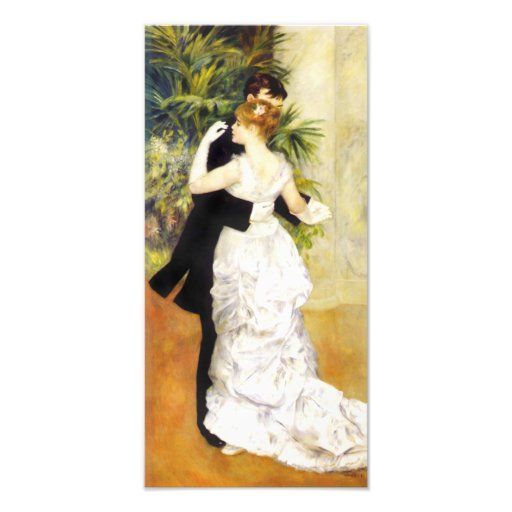
I love art that speaks about its time. Manet, Renoir, Van Gogh have immortalized the Belle Époque, the second french empire with its Haussmanian boulevards, weekends on the grass and Moulin Rouges. Until then, painting was meant to represent reality but photography was much better at that than painters. Impressionnists were the first ones to say "fuck reality!" and draw objects with fuzzy brush strokes just because they felt like it.


In the same generation, Henri Matisse started using non-realistic color (like painting an apple blue, or flesh green, for example) and not far after that, Picasso invented cubism. How to describe cubism? Well, it's the style people use to make fun of people's faces! Eyes, mouths at the wrong place...if you look at them the wrong way. If you look at them right, you'll see three dimensions on a two-dimensional canvas.


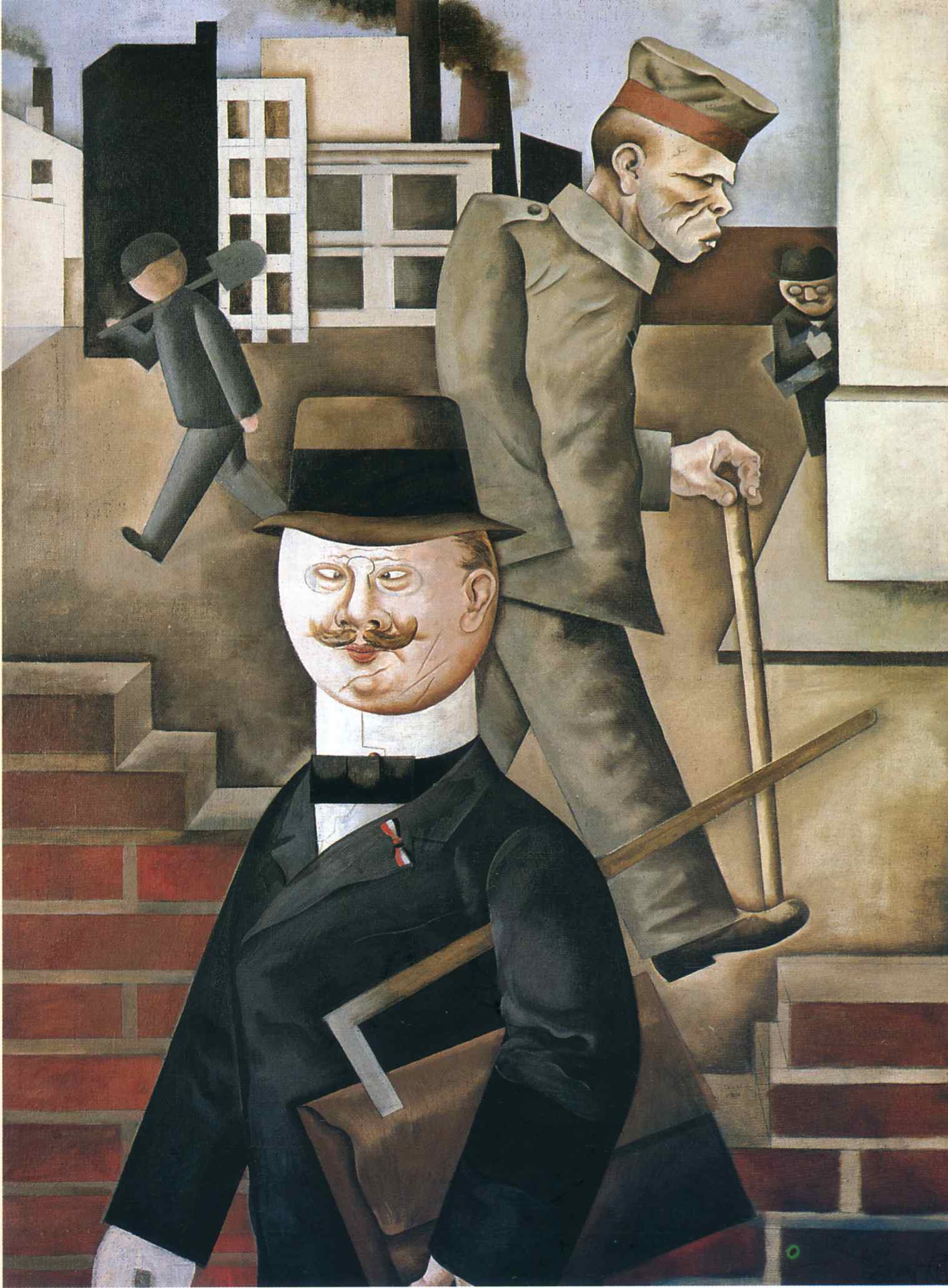
Meanwhile, across the Rhine were the German Expressionists. Their films, "Metropolis", "Der Golem", "The Cabinet of Dr. Caligari" are still cited by nerds around the internet. Those people were good enough to be called "degenerates" by the nazis (what a compliment, coming from them!) but when you look at those films, along with the paintings of Otto Dix and George Grosz, you look through a window of everything wrong with Germany at that time, how a very civilized country ended up falling for the nazis.


Meanwhile, all the cool artists migrated to the US, making New-York the new centre of the World of arts. Picasso stayed behind to point Guernica to the nazis and answer "No, you did it!". A little later, Andy Warhol immortalized movie stars, brands and presidents, the new powers, the new monarchs of the twentieth century, like Velazquez and Winterhalter painted kings and queens at a time when there were still kings and queens.

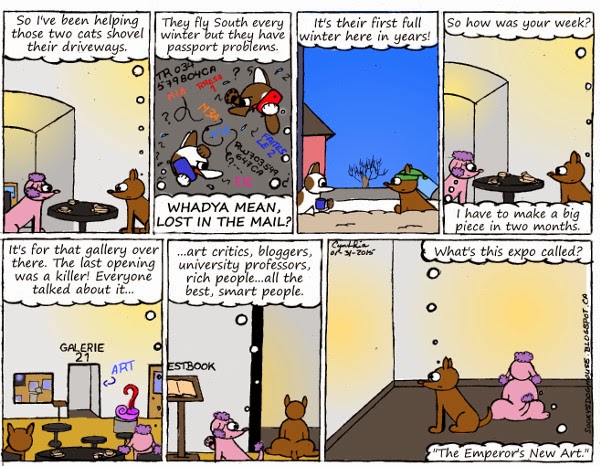
Strangely, just at the time the center of the art world moved to New York (supposed to be a sign of democratization), it took pride in becoming more and more inaccessible to the common person.  Between movies, the internet, music and TV, we are awashed in art. Mainstream art, aka "ghastly art", if you listen to the people in galleries.

In the last few decades, fine art has come to mean less and less. It doesn't know what it is, just what it is not: just "not mainstream". A desperate attempt to prove everyone that art is that thing waaay above everyone's heads while it can do publicity stunts as cheap and stupid as any reality show on MTV but gets respect from rich people with chardonnay, screaming in unisson the international war-cry of spoiled, elitist rich kids: "B- bbut the mainstream culture/our time/common people sucks!"

What a timeless complaint about time. If we zapped ourselves to the early 1900s Paris, or any other time, we would hear the same complaint: "What vulgarity!", "What an epoch we live in!". It's nothing ground-breaking, it's the stuff bitter, reactionnary people say, not artistic geniuses.
If you ever find yourself thinking that, remind yourself of how you were at age ten, asking old people "What were the 1940s like?" and remember that one day, when you'll be 73, another wide-eyed kid will ask you what the 2010's were like. They will not look at the exclusive art galleries, but at the "ghastly" mainstream culture like we look at the impressionists of la Belle Époque.

Tuesday, January 27, 2015

D) Toutes ces réponses


Est ce que c'est:

A) Un commentaire sur les matins d'hiver
B) Une allusion a deux oncles voisins qui se détestent avec passion
C) Une parodie de Bon Cop/Bad Cop

All of the above...


Is this:

A) A commentary on winter mornings
B) An allusion to two uncles who lived next toor to each other yet hated their gut with a passion?
C) A parody of Bon Cop/ Bad Cop


Monday, January 19, 2015

"Mon pays, ce n'est pas un pays, c'est l'hiver!"


You know that song lyrics have really sunk into a nation's identity when you know the sentence, but don't know the author. I needed google to make sure that it was Gilles Vigneault and not Felix Leclerc who sung "Mon pays ce n'est pas un pays c'est l'hiver" ("My country is not a country, it's winter") but darn, does it ever sum up my idea of Canada!

My idea of canadian citizenship, for example, is pretty simple: no matter if you are from El Salvador, Somalia, Algeria or anywhere else before you landed here, if you shovel snow in the winter, you're part of the tribe. I've known many immigrants and no matter where they are from (especially if they are from muslim countries) there is always a stupid Jack telling them "You're not as canadian as me!" or a stupid Jacques telling them "T'est pas pure laine, comme moi!".

And half the time, those idiots go spend the winter somewhere south because they're not "canadian" enough to stand a little snow!